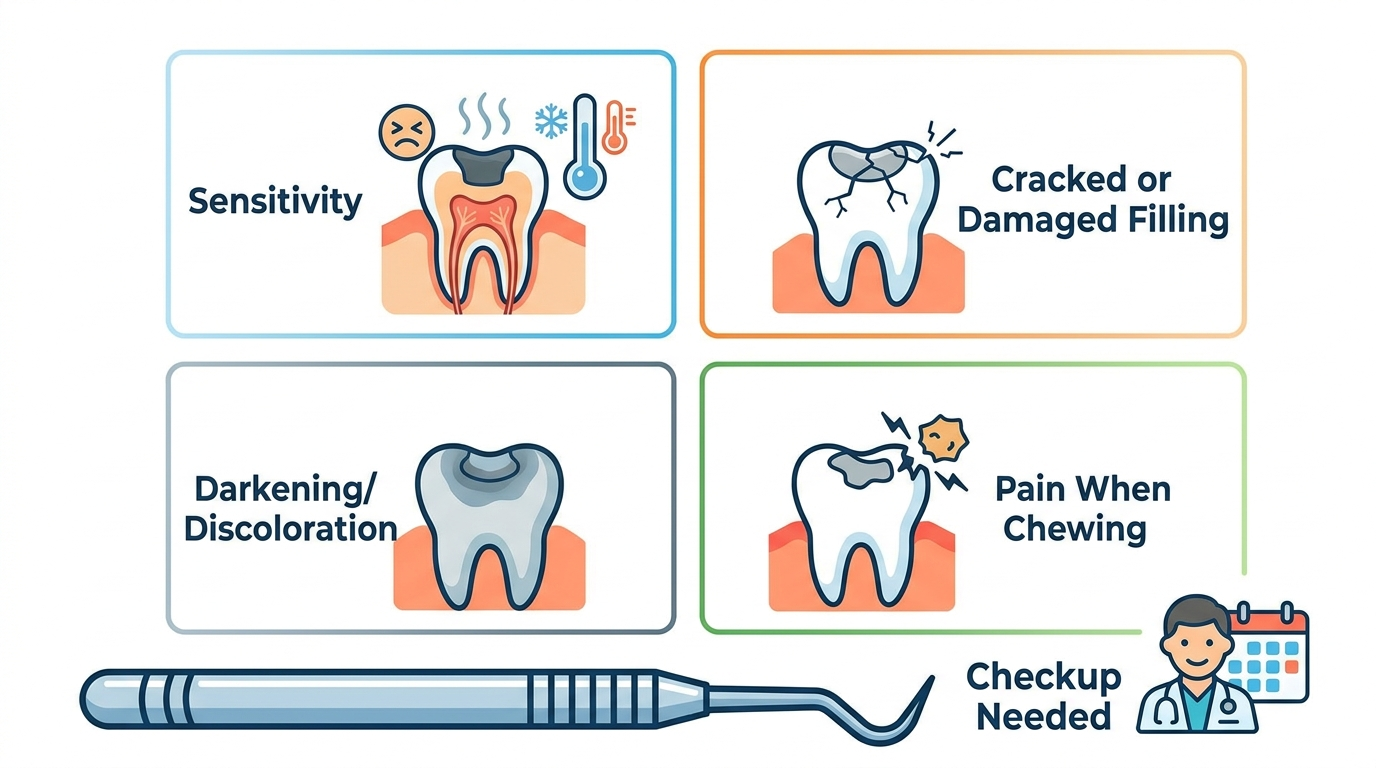
Dental fillings are not permanent. Whether you have an older amalgam filling or a more recent composite restoration, every filling has a functional lifespan, and recognizing the signs of wear or failure early can prevent a straightforward replacement from becoming a more complex and costly problem.
What You Need to Know
A dental filling may need to be replaced if it is cracked, worn down, leaking at the margins, or causing pain and sensitivity. Fillings that have failed allow bacteria to re-enter the tooth, which leads to secondary decay beneath the restoration.
How Long Do Dental Fillings Last?
Filling lifespan depends on the material used, the size of the restoration, where it sits in the mouth, and how well you maintain your oral hygiene. Amalgam (silver) fillings can last 10 to 15 years in many cases. Composite (tooth-coloured) fillings typically have a shorter functional lifespan, particularly in high-pressure areas like the back molars.
No filling lasts forever. The repeated stress of chewing, grinding, and temperature changes gradually weakens the bond between the filling material and the tooth structure around it.
Signs Your Dental Filling Needs to Be Replaced
You Feel Pain When Biting or Chewing
Pain or discomfort when you bite down on a filled tooth is one of the clearest indicators that something is wrong with the restoration. A filling that has shifted, cracked, or lost its proper shape can create uneven pressure on the tooth, causing pain that was not previously there. This type of pain should never be ignored, as biting stress on a compromised filling can cause the tooth itself to crack.
Increased Sensitivity to Hot, Cold, or Sweet
Some sensitivity after a filling is placed is normal and usually resolves within a few weeks. Sensitivity that appears in a tooth that was previously comfortable, or that intensifies over time, suggests that the filling seal has broken down and the inner layers of the tooth are being exposed to temperature and sugar. This is often an early warning sign of secondary decay forming beneath the filling.
You Can See or Feel a Crack in the Filling
Fillings can crack from years of chewing pressure, teeth grinding (bruxism), or impact. In some cases you can feel a sharp or rough edge with your tongue. In other cases the crack is only visible on close examination or on a dental X-ray. A cracked filling no longer seals the tooth effectively and needs to be replaced promptly.
The Filling Feels Loose or Has Fallen Out
A filling that feels loose when you press on it or that has partially or fully dislodged is an urgent situation. The exposed tooth structure is vulnerable to bacteria, temperature, and further fracture. You should contact your dentist promptly rather than waiting for a routine appointment.
Dark Staining Around the Edges of the Filling
Dark discolouration around the margins of an older amalgam filling is not always a sign of failure on its own. However, when darker staining appears at the border of a composite filling, it can indicate that the seal between the filling and the tooth has broken down and secondary decay is forming underneath.
Only a dentist can distinguish between staining and active decay, which is why periodic X-rays are part of routine check-ups.
Your Tooth Aches Persistently Without an Obvious Trigger
A dull, persistent toothache in a filled tooth, particularly one that does not require a hot or cold stimulus to start, may indicate that decay beneath the filling has reached the pulp of the tooth. At this stage, a simple filling replacement is no longer sufficient and root canal treatment may be required.
The Filling Is Simply Old
Even a filling that looks intact and causes no symptoms may need to be replaced if it is old enough. Older amalgam restorations can develop micro-gaps at the margins that are not visible to the naked eye but allow bacteria to penetrate slowly over time.
Types of Dental Fillings and How They Age
| Filling Type | Typical Lifespan | Common Failure Signs |
|---|---|---|
| Amalgam (Silver) | 10-15+ years | Cracking, marginal breakdown, dark staining around edges |
| Composite (Tooth-coloured) | 5-10 years | Wear, chipping, colour change, loss of seal at margins |
| Glass Ionomer | 5 years or less | Wear, surface erosion, fracture in high-pressure areas |
| Ceramic/Porcelain Inlay | 10-15+ years | Fracture under heavy chewing force |
Composite fillings in back teeth are subject to higher chewing forces and tend to wear faster than those placed on front teeth. Your dentist will factor in filling location and bite load when advising on replacement timing.
Where Can I Get My Dental Filling Replaced in Karachi?
If you suspect your filling needs attention, The Dental Clinic in Karachi is worth a visit before the problem progresses. Dr. Saqib Minhas and his team assess restorations with clinical precision, using X-rays and direct examination to determine whether a filling can be monitored or needs to come out.
They handle everything from straightforward replacements to cases where secondary decay has set in and the tooth needs more involved treatment. You can book directly through thedentalclinic.com.pk.
How Much Does Dental Filling Replacement Cost in Karachi?
At The Dental Clinic, a consultation for dental filling assessment and replacement costs just PKR 2,000. The team of expert dental surgeons will examine your existing restorations, take any necessary X-rays, and give you a clear picture of what needs to be done and what the treatment will involve from there.
Services We offer:
Titanium Implants | Swiss Implants | German Implants | Korean Implants
Composite Bonding | Fluoride Treatment | Teeth Gap Closure | Invisible Aligners
Frequently Asked Questions
How often should dental fillings be checked?
Dental fillings should be examined at every routine check-up, which for most patients means once or twice a year. Your dentist will inspect the margins of the filling visually and on X-ray to catch early signs of breakdown before symptoms develop.
Can a filling be repaired instead of fully replaced?
In some cases a small chip or surface defect in a composite filling can be bonded and repaired without full removal. However, if the filling has failed at the margin, if decay is present, or if the structural integrity is compromised, full replacement is the appropriate approach.
Does replacing a filling hurt?
Filling replacement is performed under local anesthesia, so the procedure itself should be painless. Some mild sensitivity in the treated tooth in the days following is normal and generally resolves on its own.
Can decay form under a filling that looks fine on the surface?
Yes. Secondary decay beneath a filling can develop without any visible surface signs. This is why dental X-rays are an important part of routine care, as they reveal decay between teeth and under existing restorations that cannot be seen with the naked eye during a visual examination.
Is it safe to leave an old filling in place if it causes no symptoms?
Not always. Older fillings, particularly amalgam restorations, can develop marginal breakdown and micro-gaps that allow bacteria to penetrate even when they appear intact.
Price Guides