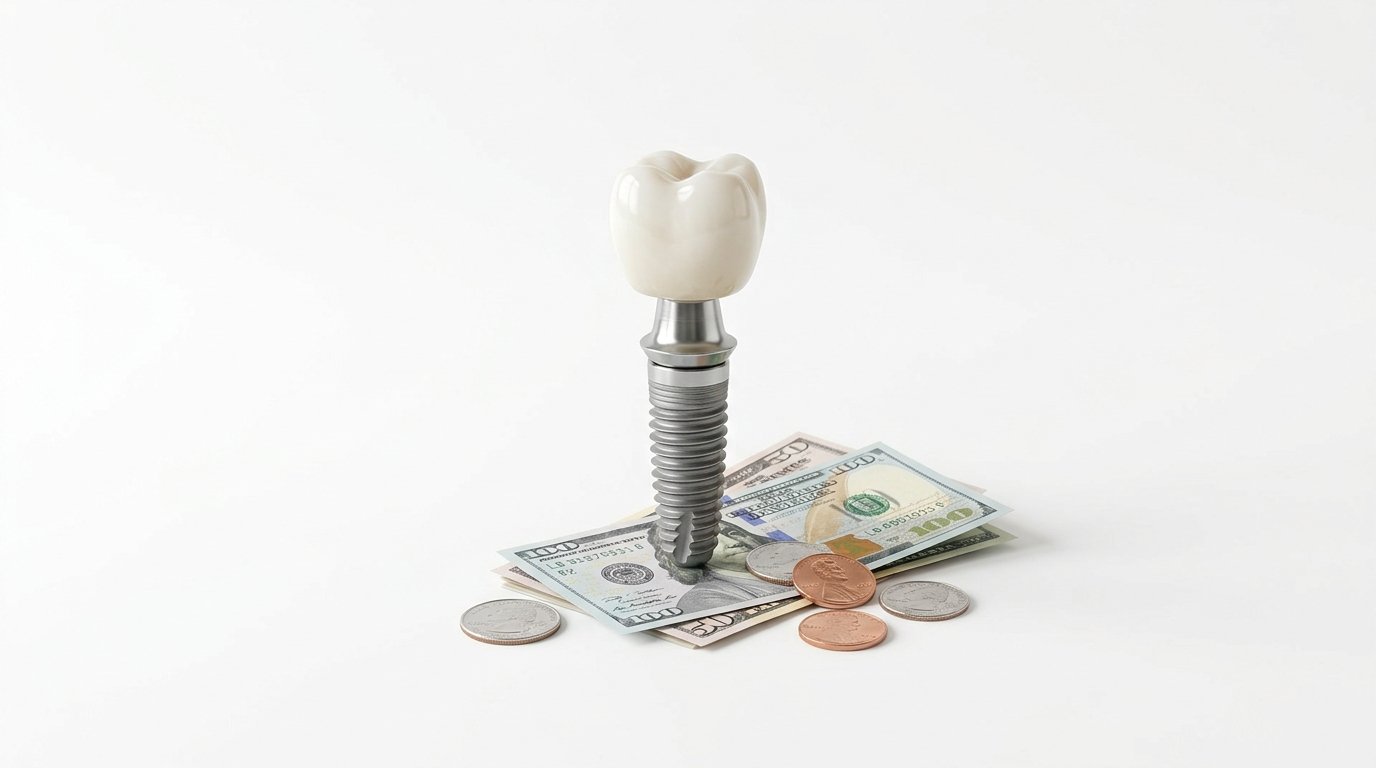
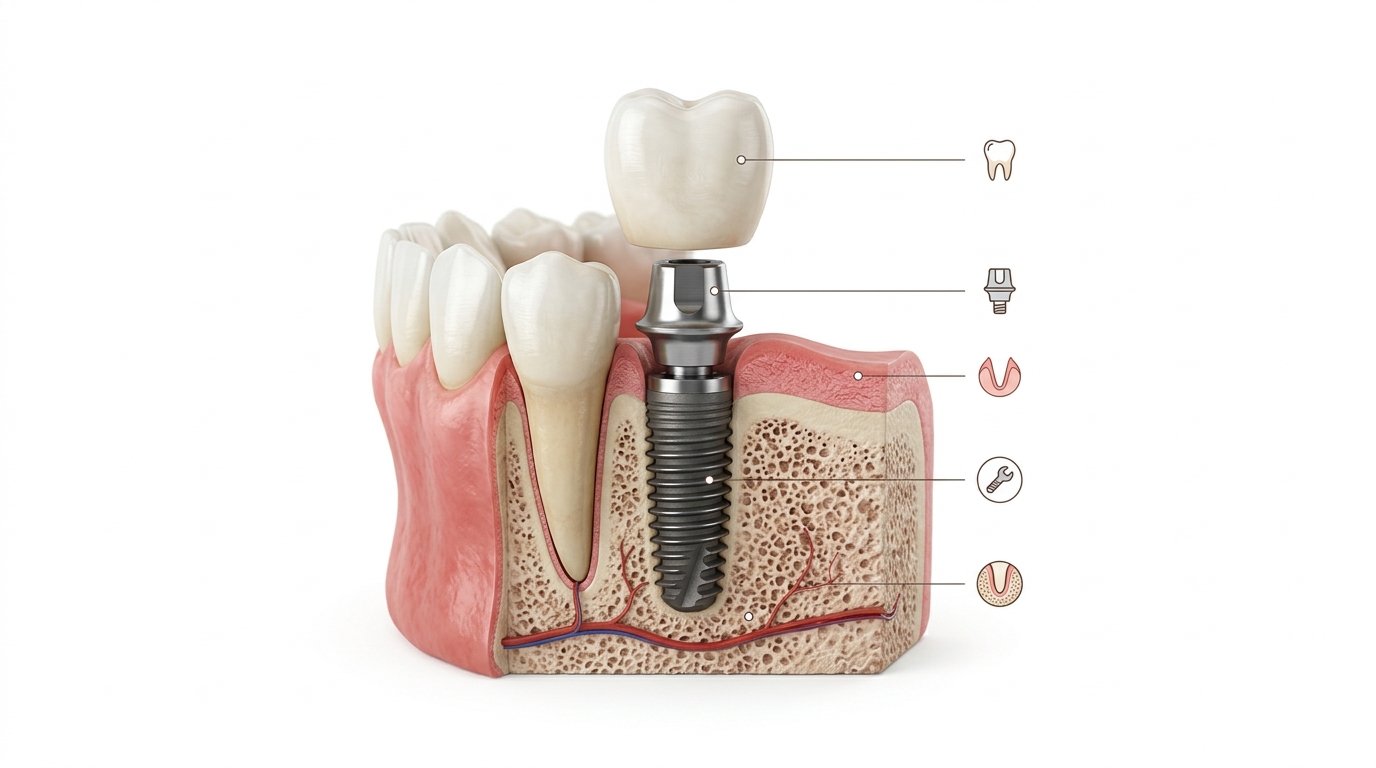
A dental implant is a tooth replacement system designed to replace a missing tooth and support a natural-looking restoration. Understanding dental implant structure helps patients learn how an implant replaces a tooth, how its components connect, and how it functions inside the mouth.
A conventional dental implant system consists of three main components: the implant fixture, abutment, and dental crown. The fixture is placed in the jawbone, the abutment connects the fixture to the restoration, and the crown replaces the visible part of the missing tooth.
At TheDentalClinic.com.pk, patients can explore dental implant treatment options and receive a professional assessment to determine which implant design and restoration suit their dental needs.
What Is the Structure of a Dental Implant?
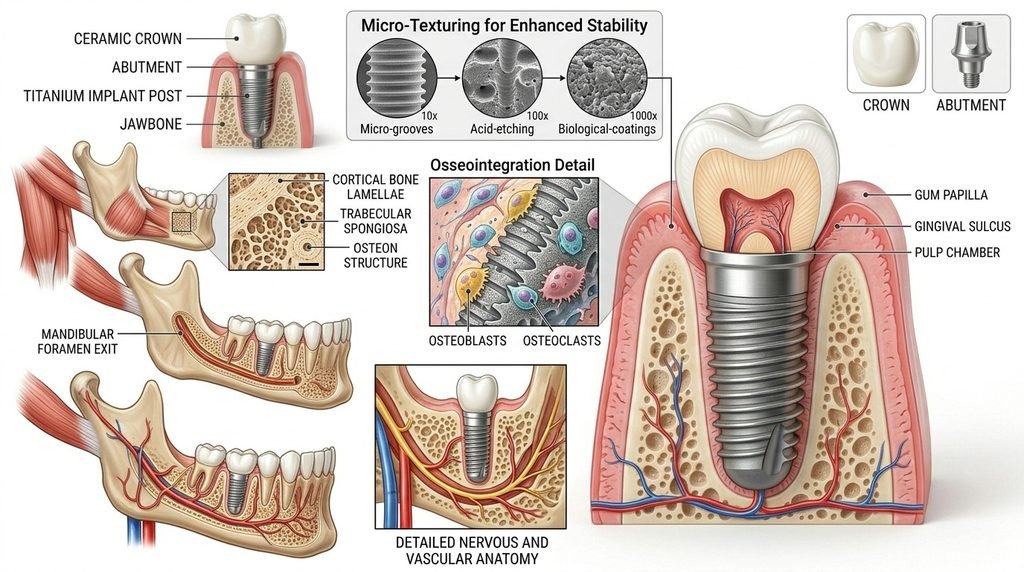
The structure of a dental implant refers to the arrangement of its components and how they work together to replace a missing tooth. Unlike a removable denture, a conventional dental implant is anchored in the jawbone and supports a fixed restoration.
The complete dental implant system includes the implant fixture, abutment, and crown, along with supporting components that may be required depending on the implant design.
The Three Main Parts of a Dental Implant
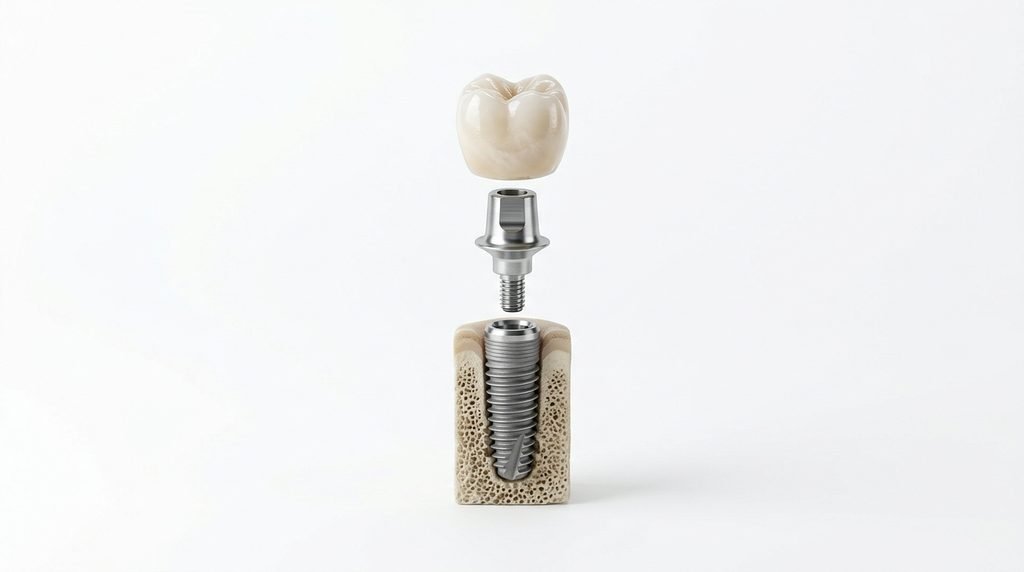
The three primary parts of a conventional dental implant are:
- Implant fixture: The component placed inside the jawbone that provides support for the replacement tooth.
- Abutment: The connector that joins the implant fixture to the dental restoration.
- Dental crown: The visible, tooth-shaped restoration that restores the appearance and function of the missing tooth.
These components must be compatible and correctly positioned to provide a stable and functional tooth replacement.
How Do Dental Implant Components Fit Together?
The implant fixture is placed in the jawbone, where it can integrate with the surrounding bone during healing. The abutment connects to the fixture and provides support for the crown.
The crown is attached to the abutment, either through a screw-retained connection or, in some designs, dental cement. The precise arrangement depends on the implant system and the treatment plan.
Which Parts of a Dental Implant Are Visible?
The dental crown is the part usually visible above the gumline. The implant fixture remains beneath the gums within the jawbone, while the abutment is generally positioned near or above the gumline.
The visibility of the abutment depends on the restoration design, gum contour, and implant position.
What Are the Main Components of a Dental Implant?
Understanding the function of each dental implant component helps explain how the system supports a replacement tooth.
1. Implant Fixture (Implant Post)
The implant fixture, also called the implant body or implant post, is the part surgically placed in the jawbone. It acts as the foundation for the replacement tooth.
Most conventional dental implant fixtures are made from commercially pure titanium or titanium alloys. Zirconia fixtures are also available in selected implant systems.
The fixture is designed to provide stability and support the forces generated during chewing.
Main parts of an implant fixture include:
- Implant body: The main portion of the fixture positioned within the jawbone.
- Threads: Grooves along the fixture that help provide initial mechanical stability during placement.
- Apex: The terminal end of the implant fixture.
- Implant surface: The outer surface, which may have specific textures or treatments designed to support bone integration.
- Internal or external connection: The interface where the abutment or another compatible component connects to the fixture.
The exact design varies by implant manufacturer and system.
How Does the Implant Fixture Connect to the Jawbone?
After placement, the surrounding bone heals around the implant surface through a process called osseointegration. This process involves a direct structural connection between living bone and the implant surface.
Successful osseointegration helps provide long-term support for the restoration. Healing time varies depending on bone quality, implant stability, the patient’s health, and the treatment plan.
2. Dental Implant Abutment
The dental implant abutment is the connecting component between the implant fixture and the crown or other restoration.
It attaches to the fixture through a compatible implant connection and provides a platform for supporting the replacement tooth.
Abutments may be made from titanium, titanium alloys, or zirconia, depending on the clinical requirements.
Common abutment options include:
- Stock abutments: Prefabricated components available in standard shapes and sizes.
- Custom abutments: Individually designed to suit the implant position, restoration, and surrounding gum contour.
- Angled abutments: Components designed to help manage certain implant-positioning or restorative challenges when clinically appropriate.
What Does an Implant Abutment Do?
The abutment connects the implant fixture to the restoration and helps support the forces transmitted through the replacement tooth.
Its design can also influence the emergence profile of the crown, the appearance of the gumline, and access for cleaning.
Correct abutment selection is important for achieving a well-fitting restoration that functions comfortably.
3. Dental Implant Crown
The dental implant crown is the visible, tooth-shaped restoration that replaces the missing tooth above the gumline.
Unlike a natural tooth crown, an implant crown is not attached to a natural root. It is supported by the implant fixture through an abutment or a compatible implant-supported connection.
Common crown materials include:
- Zirconia: A strong ceramic material frequently used for implant-supported crowns.
- Other dental ceramics: Selected according to aesthetic and functional requirements.
- Porcelain-fused-to-metal: A restoration combining a metal substructure with an outer porcelain layer.
The choice depends on the tooth’s location, bite forces, aesthetic expectations, available space, and the overall treatment plan.
How Is a Dental Implant Crown Attached?
An implant crown can be attached using one of two common approaches:
- Screw-retained crown: A screw secures the restoration to the implant or abutment. This design can allow easier removal for maintenance when necessary.
- Cement-retained crown: Dental cement secures the crown to an abutment. This approach can be useful in selected restorative situations but requires careful cement management.
The dentist selects the attachment method according to the implant position, restoration design, and clinical requirements.
Other Parts Used in a Dental Implant System
Not every dental implant requires every additional component. Some parts are used during healing, while others form part of the final restoration.
Implant Screw and Abutment Screw
The retaining screw secures compatible components within the implant system. Depending on the design, it may hold the abutment or a screw-retained crown in position.
Correct screw selection and tightening according to manufacturer specifications help reduce the risk of mechanical complications.
Cover Screw
A cover screw may be placed over the implant fixture during a submerged healing approach. It helps protect the implant connection while the surrounding tissues heal.
It is not required in every implant procedure.
Healing Abutment
A healing abutment is attached to the implant to help guide the surrounding gum tissue during healing. It generally extends through the gumline and helps establish a suitable tissue contour for the final restoration.
Prosthetic Connection and Implant Platform
The prosthetic connection is the interface between the implant fixture and its compatible restorative component. The implant platform is the area where these components meet.
Connection design and component compatibility influence the fit, stability, and maintenance of the implant-supported restoration.
Dental Implant Structure: How the Parts Connect
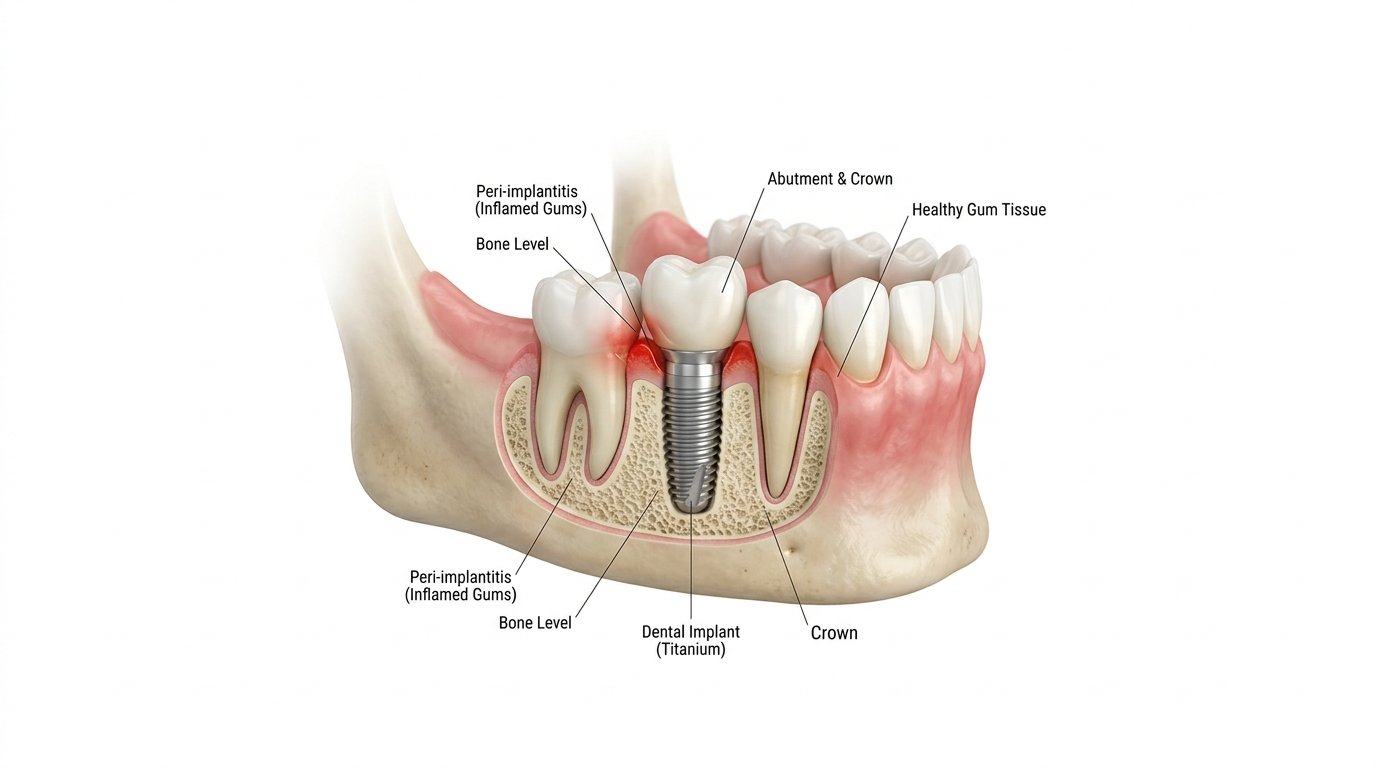
A labelled dental implant structure diagram can help patients understand the position and function of each component.
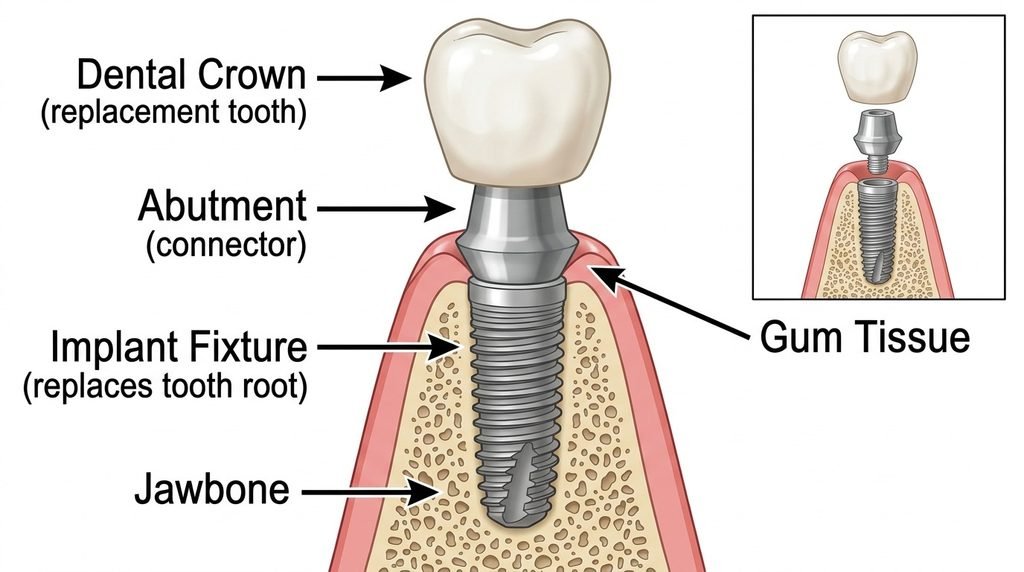
From top to bottom, a conventional implant-supported tooth generally includes:
- Dental crown: The visible replacement tooth.
- Abutment: The connector supporting the crown.
- Retaining screw or attachment: The mechanism used in compatible restoration designs.
- Implant fixture: The component positioned within the jawbone.
- Surrounding gum tissue and jawbone: The tissues supporting and surrounding the implant system.
The exact arrangement varies according to the implant design and restoration type.
The fixture provides the foundation, the abutment connects the restorative components, and the crown restores the visible tooth. Together, these parts form a functional tooth replacement system.
How Does Dental Implant Structure Support a Replacement Tooth?
Each component has a specific role in restoring chewing function and replacing the visible tooth.
How Osseointegration Stabilizes the Implant
The implant fixture is designed to integrate with the surrounding jawbone. This biological process provides support for the implant after healing.
Initial mechanical stability and later bone integration both contribute to the overall stability of the implant system.
How the Abutment Connects the Implant to the Crown
The abutment creates a connection between the fixture and the final restoration. Its position and shape help determine how the crown fits and how the restoration emerges through the gum tissue.
How Implant Components Handle Chewing Forces
During chewing, forces pass through the crown and restorative connection to the implant fixture and surrounding bone.
The distribution of these forces depends on implant position, crown design, bite alignment, bone support, and the patient’s chewing habits.
A properly planned restoration aims to manage these forces while maintaining comfort and function.
Why Precise Component Fit Matters
Poorly fitting components, unsuitable bite forces, or inadequate maintenance can contribute to mechanical complications and tissue problems.
Professional planning, compatible components, appropriate placement, and regular follow-up help support the long-term performance of a dental implant.
What Materials Are Used in Dental Implant Components?
Dental implant materials are selected according to their strength, biocompatibility, appearance, and intended function.
| Implant component | Common materials | Main purpose |
| Implant fixture | Titanium, titanium alloys; zirconia in selected systems | Provides support within the jawbone |
| Abutment | Titanium, titanium alloys, zirconia | Connects the fixture to the restoration |
| Dental crown | Zirconia, other dental ceramics, porcelain-fused-to-metal | Replaces the visible tooth |
| Retaining screw | Commonly titanium alloy or other manufacturer-specified compatible materials | Secures restorative components |
Titanium Dental Implants
Titanium and its alloys are widely used for implant fixtures because of their mechanical properties, biocompatibility, and established clinical use.
Zirconia Dental Implants and Restorations
Zirconia is a ceramic material used in certain implant fixtures and restorative components. Its tooth-coloured appearance can be useful in selected clinical situations.
Zirconia crowns and abutments should not be confused with zirconia implant fixtures, as they serve different functions.
The most appropriate material depends on the patient’s clinical needs, the implant system, and the planned restoration.
Dental Implant Structure vs. Natural Tooth Structure
A dental implant replaces a missing tooth, but its structure differs from that of a natural tooth.
| Natural tooth structure | Dental implant structure |
| Enamel covers the visible crown | A prosthetic crown replaces the visible tooth |
| Dentin forms much of the tooth’s internal structure | A restorative crown contains the selected dental material |
| The natural root anchors the tooth in the jaw | The implant fixture is positioned within the jawbone |
| Cementum covers the natural root | The implant fixture has its own engineered surface |
| The periodontal ligament surrounds the natural root | The implant integrates directly with surrounding bone |
| The pulp contains nerves and blood vessels | The implant fixture has no natural tooth pulp |
A natural tooth is supported by a periodontal ligament that helps it respond to pressure. A dental implant does not have this ligament and therefore responds differently to chewing forces.
An implant can restore chewing function, but it does not reproduce every biological feature of a natural tooth.
Why Is the Structure and Quality of a Dental Implant Important?
The quality and compatibility of implant components affect how the restoration fits, functions, and can be maintained over time.
Important considerations include:
- Component compatibility: The fixture, abutment, and retaining screw must be designed to work together.
- Implant positioning: Appropriate placement supports function, restoration design, and access for cleaning.
- Crown fit and bite alignment: A well-designed restoration helps manage chewing forces.
- Gum and bone health: Healthy supporting tissues are essential for maintaining the implant.
- Maintenance: Regular professional reviews and effective daily cleaning help reduce the risk of complications.
Dental implants can develop problems such as screw loosening, crown damage, inflammation around the implant, or loss of supporting bone. Appropriate planning and maintenance help reduce risks but cannot eliminate them entirely.
Choosing an implant system involves more than looking at the fixture alone. The complete restoration, clinical assessment, placement, and ongoing care all matter.
Services We offer:
Titanium Implants | Swiss Implants | German Implants | Korean Implants
Composite Bonding | Fluoride Treatment | Teeth Gap Closure | Invisible Aligners
Frequently Asked Questions
What Are the Three Main Parts of a Dental Implant?
The three main parts of a conventional dental implant system are the implant fixture, abutment, and crown. The fixture supports the implant within the jawbone, the abutment connects the fixture to the restoration, and the crown replaces the visible tooth.
Is a Dental Implant Just a Screw?
No. The implant fixture may resemble a screw, but a complete dental implant restoration generally includes a fixture, a restorative connection or abutment, and a crown. Additional components may be used depending on the design.
What Is the Difference Between an Implant Fixture and an Abutment?
The fixture is positioned within the jawbone and provides the foundation for the restoration. The abutment connects the fixture to the crown or another implant-supported restoration.
Which Part of a Dental Implant Is Visible?
The crown is usually the visible part of the implant-supported tooth. The fixture is located within the jawbone, while the abutment is generally near or above the gumline.
What Materials Are Dental Implants Made Of?
Implant fixtures are commonly made from titanium or titanium alloys, while zirconia fixtures are available in selected systems. Abutments may be made from titanium or zirconia, and crowns may use zirconia, other ceramics, or porcelain-fused-to-metal.
Can a Dental Implant Crown Be Replaced Without Removing the Implant?
In many cases, the crown can be repaired or replaced while leaving the fixture in place. The approach depends on the condition of the implant, the attachment method, and the reason for replacement.
Does Every Dental Implant Need a Separate Abutment?
No. Many conventional implant restorations use a separate abutment, but some implant systems use integrated or directly connected restorative designs. The arrangement depends on the specific system and treatment plan.
How Does a Dental Implant Attach to the Jawbone?
After placement, the surrounding bone heals and forms a direct structural connection with the implant surface through osseointegration. This process helps stabilize the fixture and support the replacement tooth.
Conclusion
Dental implant structure consists of interconnected components that work together to replace a missing tooth. The implant fixture provides support within the jawbone, the abutment connects the fixture to the restoration, and the crown restores the visible tooth.
The materials, dimensions, connection design, and positioning of these components depend on individual clinical needs. Proper planning, compatible components, and regular maintenance are essential for supporting implant function and long-term oral health.
If you are considering dental implants, The Dental Clinic can help you explore your options and arrange a professional assessment to determine a suitable treatment approach for your missing teeth.
Price Guides