
You wake up with a throbbing jaw, your face feels swollen, and pressing on your gum sends a sharp pain straight through your skull. You know something is wrong, but is it the tooth or the gum?
The answer changes everything, because a tooth abscess and a gum abscess are two different infections that develop in different locations, carry different warning signs, and require completely different treatment.
Confusing the two, or worse, ignoring either, can turn a fixable problem into a dental emergency. Here is exactly how to tell them apart.
What Is a Tooth Abscess?
A tooth abscess (periapical abscess) is a pocket of pus that forms at the root tip of a tooth. It happens when bacteria enter the inner pulp through a deep cavity, cracked tooth, or failed filling, and the infection spreads into the bone. It usually starts as untreated decay that reached the nerve, a fracture, old dental work, or trauma to the tooth.
What Is a Gum Abscess?
A gum abscess (periodontal abscess) forms in the gum tissue or the space between gum and tooth, not inside the tooth. It is almost always linked to gum disease, trapped food, or debris stuck under the gumline. The tooth root is usually not the source; the infection lives in the surrounding soft tissue.
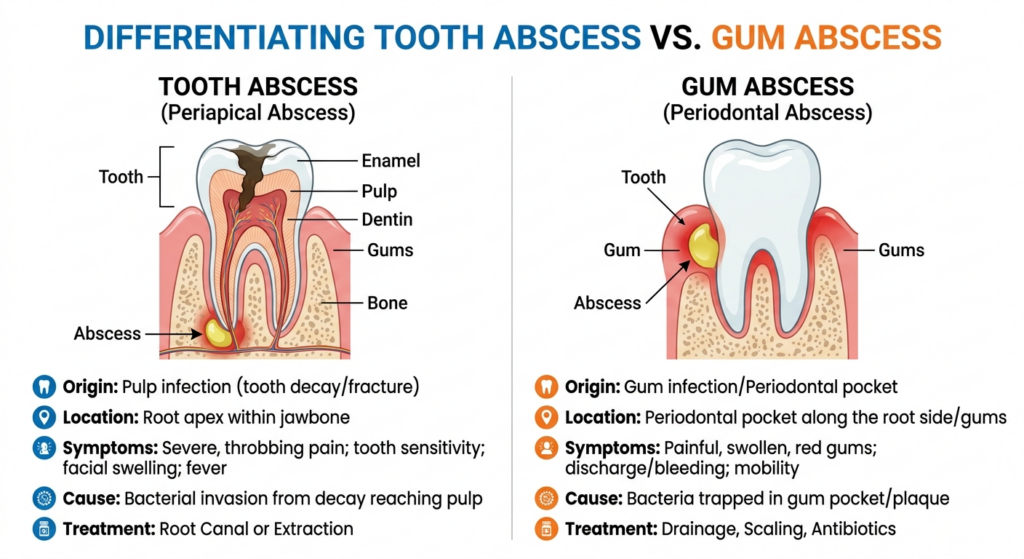
Tooth Abscess vs Gum Abscess
| Tooth Abscess | Gum Abscess | |
|---|---|---|
| Location | Root tip, inside the bone | Gum tissue or gum pocket |
| Main cause | Infected tooth pulp | Gum disease or trapped debris |
| Pain type | Deep, throbbing, constant | Localized, pressure-sensitive |
| Swelling | May cause facial swelling | Limited to gum area |
| Gum appearance | May look normal | Visibly red, swollen, shiny |
| Pus visible | Sometimes drains at gumline | Often a visible bump on gum |
| Tooth involved | Yes — tooth is the source | Tooth may be completely healthy |
| Treatment | Root canal or extraction | Deep cleaning, drainage, antibiotics |
| Danger level | High if untreated | High if untreated |
Symptoms You Should Never Ignore
A tooth abscess typically presents as severe throbbing pain that does not stop, sensitivity to hot and cold that lingers, pain when biting, swollen face or jaw, fever, swollen lymph nodes under the jaw, and a bad taste in the mouth when it drains.
A gum abscess looks and feels different, a visible bump or blister on the gum, pain when pressing on it, persistent bad breath, pus oozing from the gum, and sometimes a loose tooth in that area.
If you have facial swelling, fever, and difficulty swallowing, go to emergency care immediately. The infection has spread beyond the mouth.
Treatment for a Tooth Abscess
When the tooth structure is intact, root canal treatment is the preferred option. The infected pulp is removed, the canals are cleaned and sealed, and the tooth is restored with a crown, the tooth is saved and pain stops within days.
When the tooth is too damaged to save, tooth extraction removes the source entirely. Patients in Karachi who lose a tooth this way can restore their smile and chewing function afterward with a dental implant or a dental bridge, depending on their condition and budget.
Both paths are paired with antibiotics to clear residual infection and a follow-up to confirm healing.
Treatment for a Gum Abscess
The dentist first drains the abscess through a small incision, immediate pressure relief in most cases. This is followed by scaling and root planing, a deep cleaning procedure that removes bacterial buildup below the gumline that standard cleaning cannot reach.
If gum disease caused the abscess, a one-time cleaning is not enough. Ongoing periodontal treatment keeps infection from returning and protects the bone supporting your teeth.
Can You Treat Either One at Home?
No. Warm salt water rinses and painkillers manage symptoms temporarily. They do not eliminate the infection. Use that window to book an appointment, not to delay further.
The Dental Clinic Karachi Trusts for Abscess Treatment
Choosing the wrong clinic for an abscess, one that prescribes antibiotics and sends you home, costs you time, money, and in serious cases, your tooth. At The Dental Clinic, Karachi, we treat the source, not the symptoms.
Tooth abscesses are handled by our root canal specialists using rotary endodontic systems that make the procedure faster and significantly more comfortable than conventional methods. Most cases are completed in a single visit. Gum abscesses are managed by our periodontists who perform precision drainage and deep cleaning to eliminate the infection at its origin and prevent recurrence.

We offer same-day emergency slots for patients in acute pain, on-site digital X-rays so you leave your first appointment with a clear diagnosis and treatment plan, and full cost transparency before anything begins. Patients from DHA, Clifton, Gulshan, North Nazimabad, and beyond come to us, at our Gulshan-e-e Iqbal Branch after antibiotics failed, after months of delay, and after being told elsewhere that extraction was the only option. We assess every case independently, and we save teeth others write off.
If you are dealing with swelling, throbbing pain, or a visible bump on your gum, book an appointment today. Same-day slots are open for emergency cases.
Frequently Asked Questions
Can a tooth abscess turn into a gum abscess?
Not directly, but a tooth abscess can drain through the gum tissue creating a bump that looks like a gum abscess. The source is still the tooth. An X-ray confirms which one it is.
Will antibiotics alone fix it?
No. Antibiotics reduce bacteria but cannot remove infected pulp or drain the pus pocket. The infection returns once the course ends.
Is the treatment painful?
The abscess is painful. The treatment provides relief. Local anesthesia is used throughout, most patients feel significantly better within hours of drainage or root canal.
What does it look like on an X-ray?
A tooth abscess appears as a dark shadow at the root tip indicating bone loss. A gum abscess may not always show on X-ray, which is why clinical examination is essential alongside imaging.