Eight teeth failing in the same arch is the kind of case many clinics answer with eight separate implants, a longer timeline, and a proportionally larger bill. The number of implants a case needs is not decided by how many teeth are missing. It is decided by what the remaining bone can safely carry and how the final bridge will distribute the bite across it.
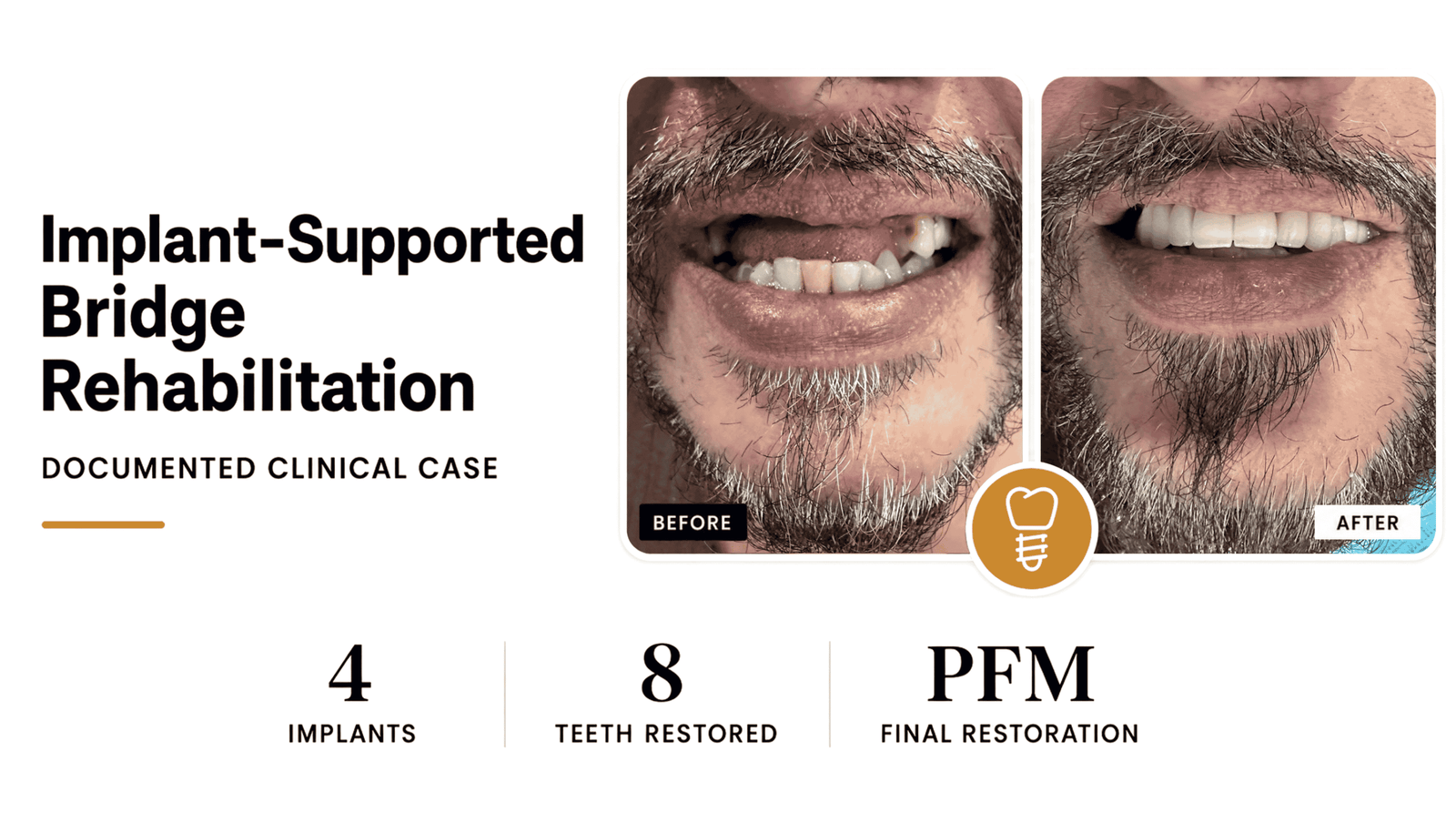
This case documents how Dr. Saqib Minhas and his team restored a full smile of 8 teeth using only 4 dental implants. The protocol was staged across surgery and prosthetics, built to protect bone volume, develop healthy soft tissue, and verify fit at every stage before the final restoration was cemented into place.
What the Patient Was Dealing With
The patient presented with several teeth that were mobile, extensively decayed, or infected beyond any restorative option. Root canal treatment, crowns, and fillings were no longer viable for these teeth, since the remaining tooth structure and supporting bone could not reliably hold a restoration long term.
Extraction was the only clinically sound starting point, followed by a planned rebuild using implant-supported prosthetics.
Cases like this require more than removing the affected teeth. The clinician has to plan, before a single extraction is made, how many implants the remaining bone can support, where those implants need to sit, and what type of prosthesis will distribute biting force safely across them.
The Treatment Plan
Dr. Saqib Minhas outlined a 6-stage protocol before beginning treatment, sequencing surgical healing, soft-tissue development, and prosthetic verification as separate, non-negotiable steps. Each stage had a defined clinical endpoint that had to be confirmed before the next stage began.
This sequencing matters because implants integrate with bone through a biological process called osseointegration, where new bone forms directly against the implant surface. Loading an implant with a permanent restoration before this process is complete is one of the most common causes of early implant failure, which is why every stage in this case was time-gated to healing rather than to a fixed calendar.
Stage 1: Removal of Hopeless Teeth and Healing
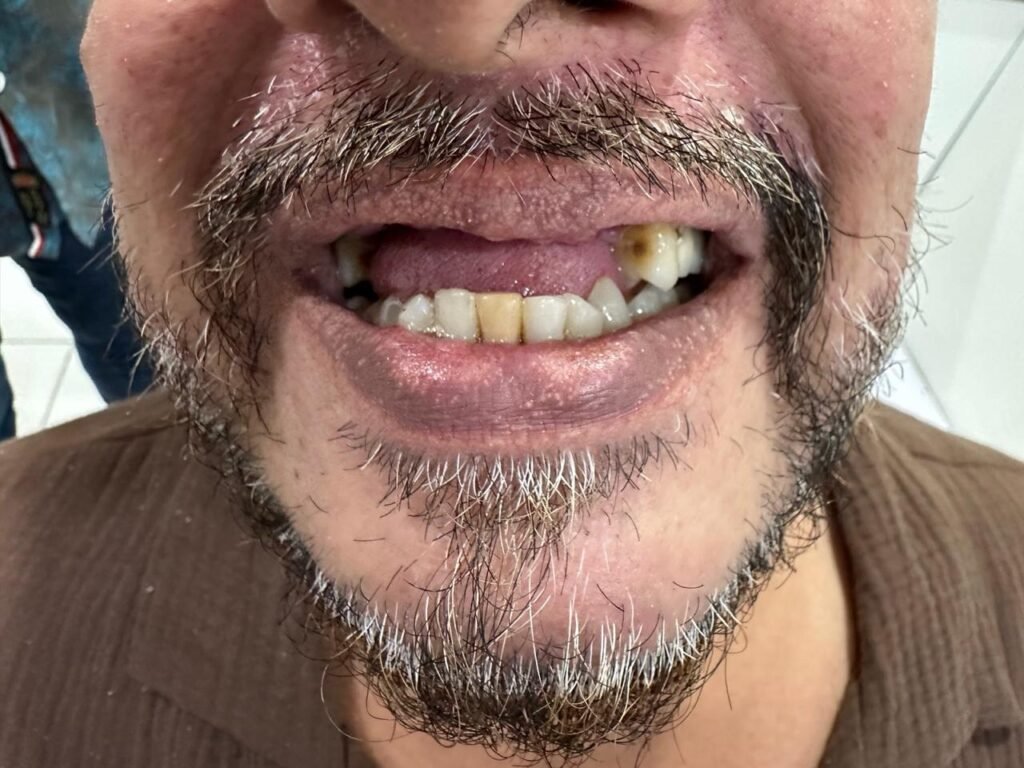
All mobile, decayed, and infected teeth were extracted in a single planned phase. None of these teeth retained enough sound structure or bone support to justify an attempt at preservation, and delaying extraction on a non-restorable tooth typically leads to further bone loss around it.
The extraction sites were then given adequate time to heal before any implant planning proceeded. Healing at this stage involves both soft tissue closure over the socket and early bone remodeling within it, and rushing this step reduces the quality of the site available for implant placement later. Intraoral photographs were taken once healing was confirmed, documenting a stable foundation before moving forward.
Stage 2: Interim/Temporary Denture
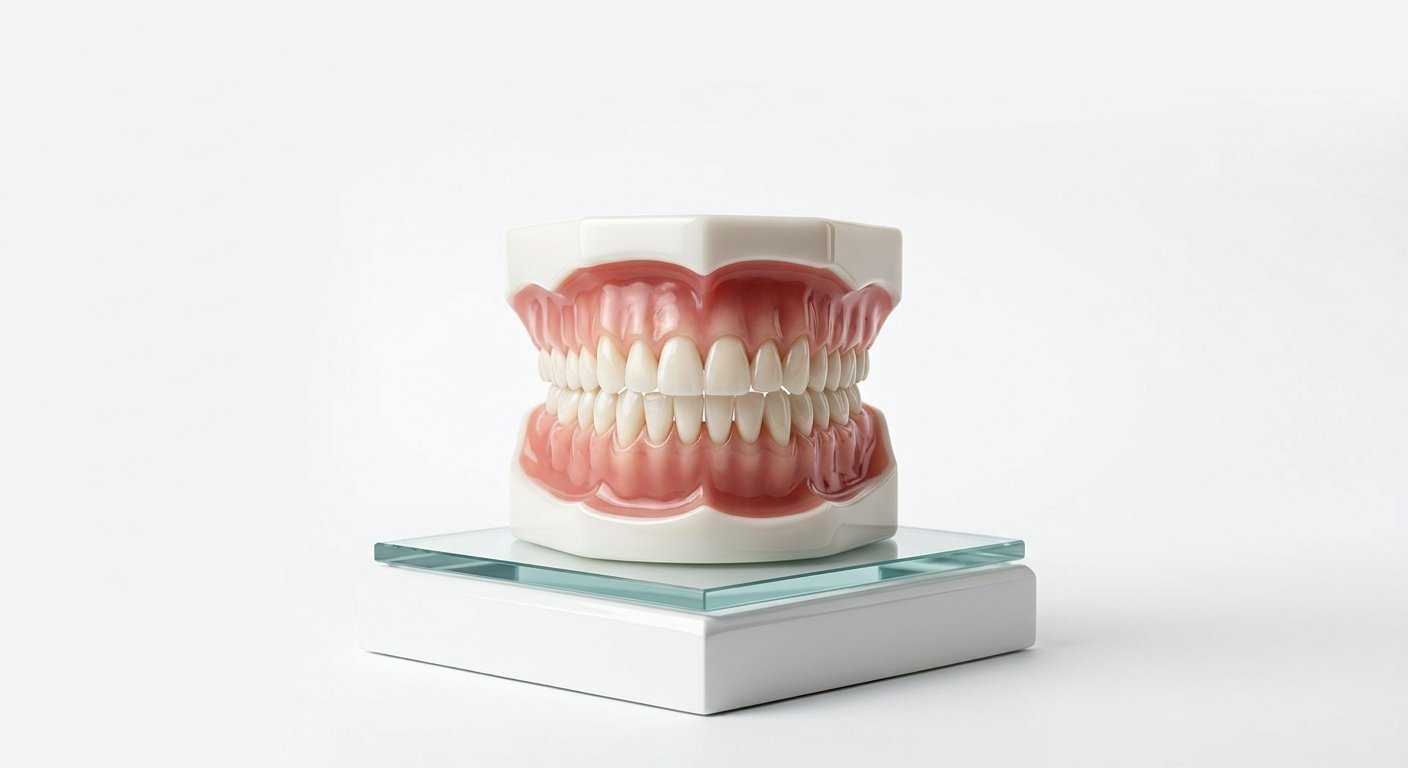
An interim denture was fitted to give the patient a functional, natural-looking set of teeth during the healing and planning period. Beyond appearance, the temporary denture let the patient adapt to the proposed tooth position, bite relationship, and speech pattern before any implant was placed, which reduces the chance of the patient needing significant adjustments once the final bridge is delivered.
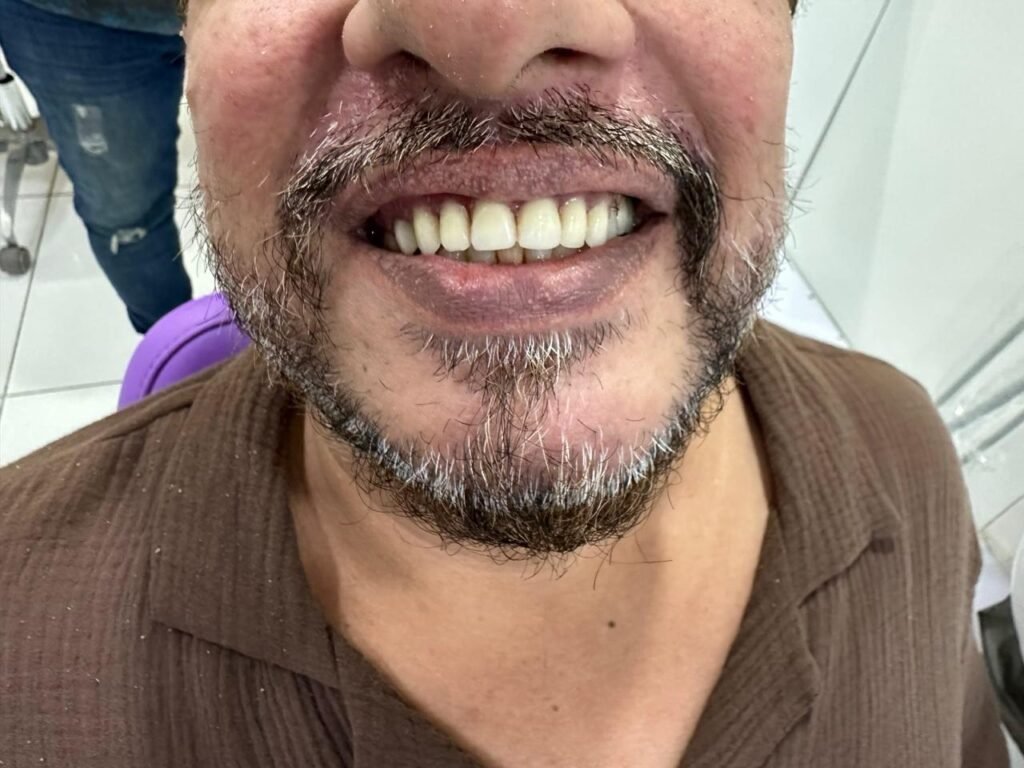
This stage also gave Dr. Saqib Minhas a working reference for the final tooth arrangement. Evaluating how the patient adjusted to the interim denture informed decisions on tooth position and occlusion carried into the definitive restoration.
Stage 3: Implant Healing and Emergence Profile
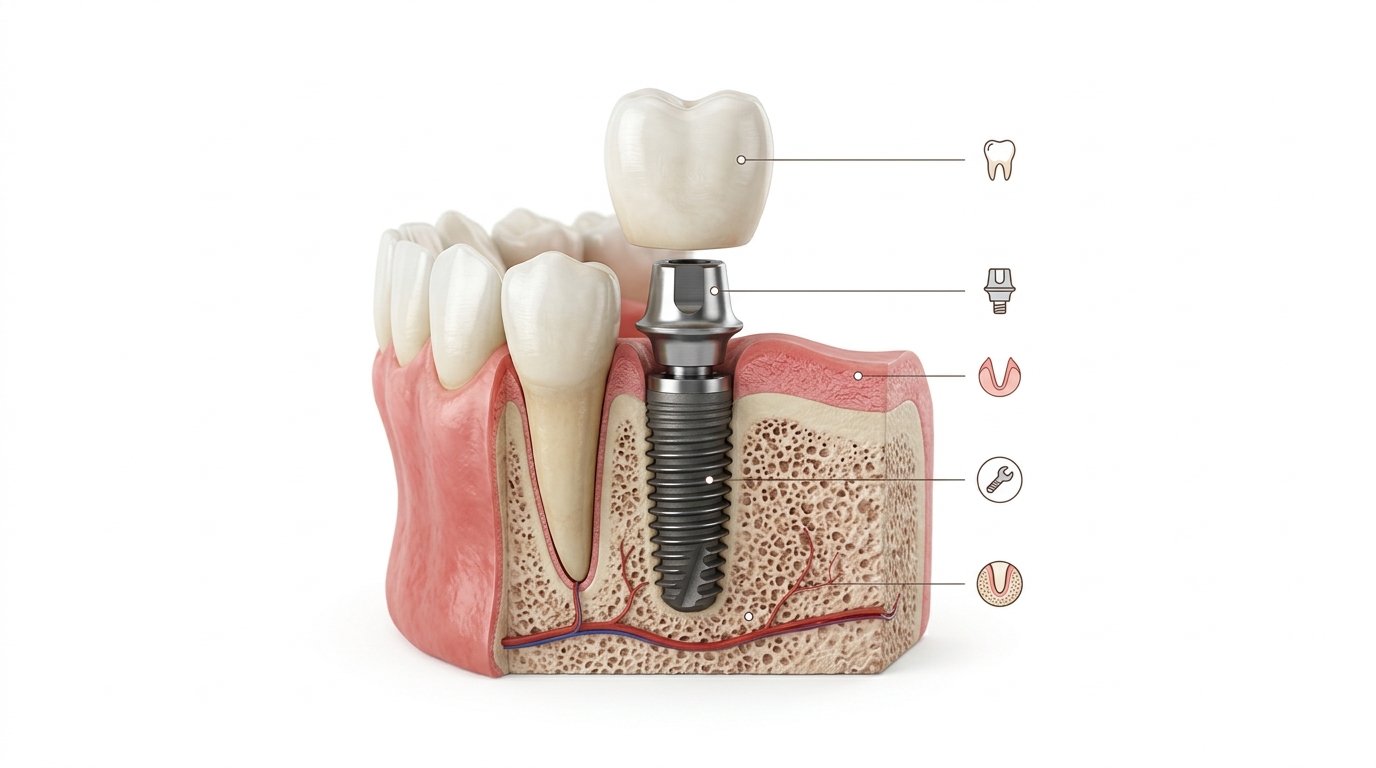
Once the 4 implants were placed and given time to integrate with the bone, healing abutments were fitted. These small connector pieces were inserted and removed as needed over several visits to shape the emergence profile, which is the contour the gum tissue takes as it meets the implant restoration.
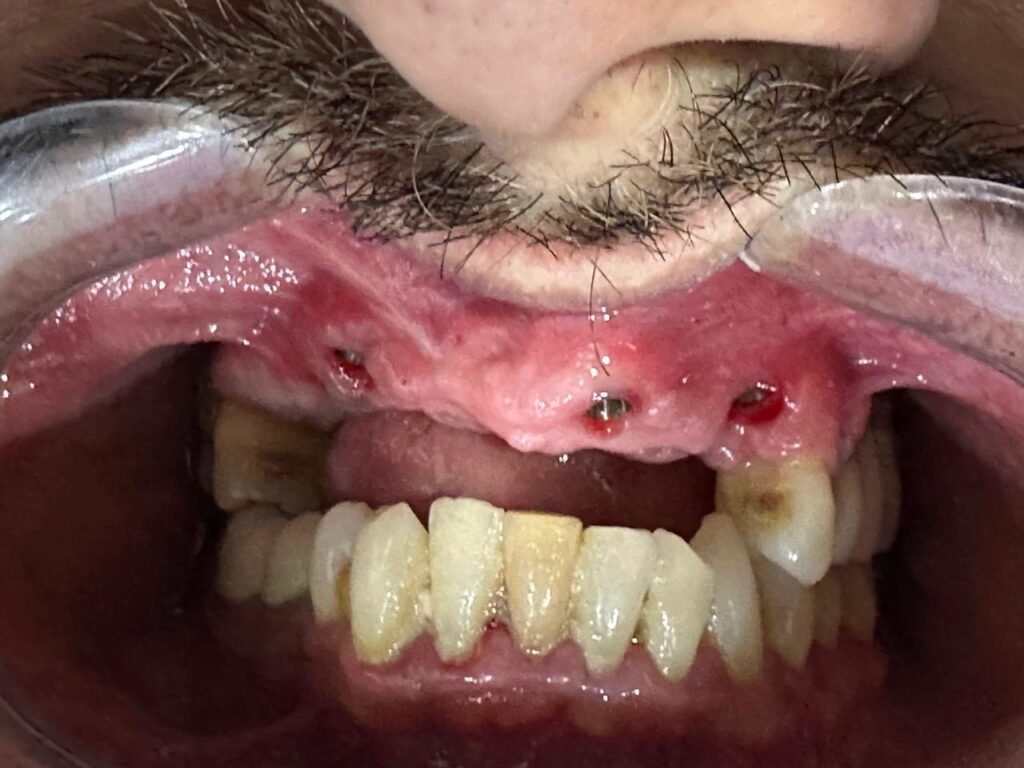
A well-developed emergence profile is what allows the final crowns to look like they are growing naturally out of the gum line rather than sitting on top of it. At this stage, all 4 implants were clinically confirmed as fully healed, with healthy, well-adapted soft tissue around each one, giving Dr. Saqib Minhas a stable and predictable foundation for the abutment and framework stages that followed.
Stage 4: Placement of Definitive Abutments
4 definitive implant abutments were placed on the healed implants. These abutments are the fixed connecting components between the implant embedded in bone and the prosthesis that sits above the gum line, and they need to be seated with precise angulation and torque.
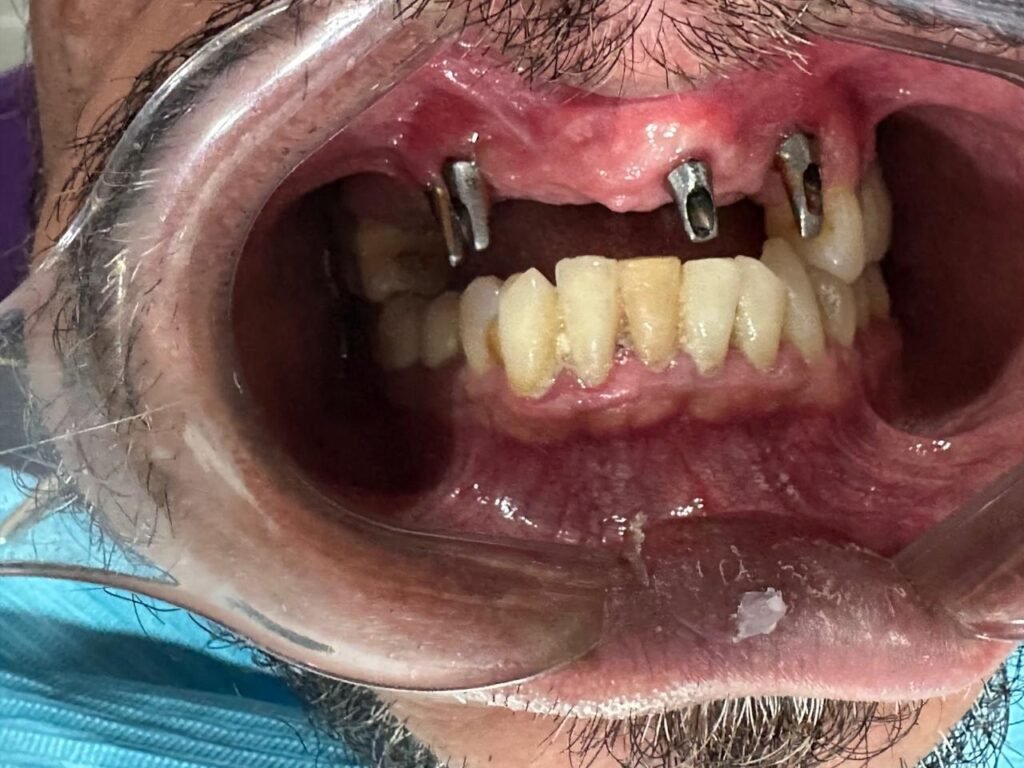
Any inaccuracy at this stage transfers directly into the fit of the final bridge, since every later stage builds on the position established here. Placing the definitive abutments only after the emergence profile was confirmed in Stage 3 reduced the risk of having to revisit this step later.
Stage 5: Metal Framework Trial Before Finalization of Case
Before any ceramic layering began, a metal framework trial was carried out to verify passive fit, framework accuracy, the inter-implant relationship, occlusal clearance, and prosthetic space. Passive fit means the framework seats fully against all 4 abutments without inducing stress into the implants, which is one of the most important checkpoints in any multi-implant restoration.
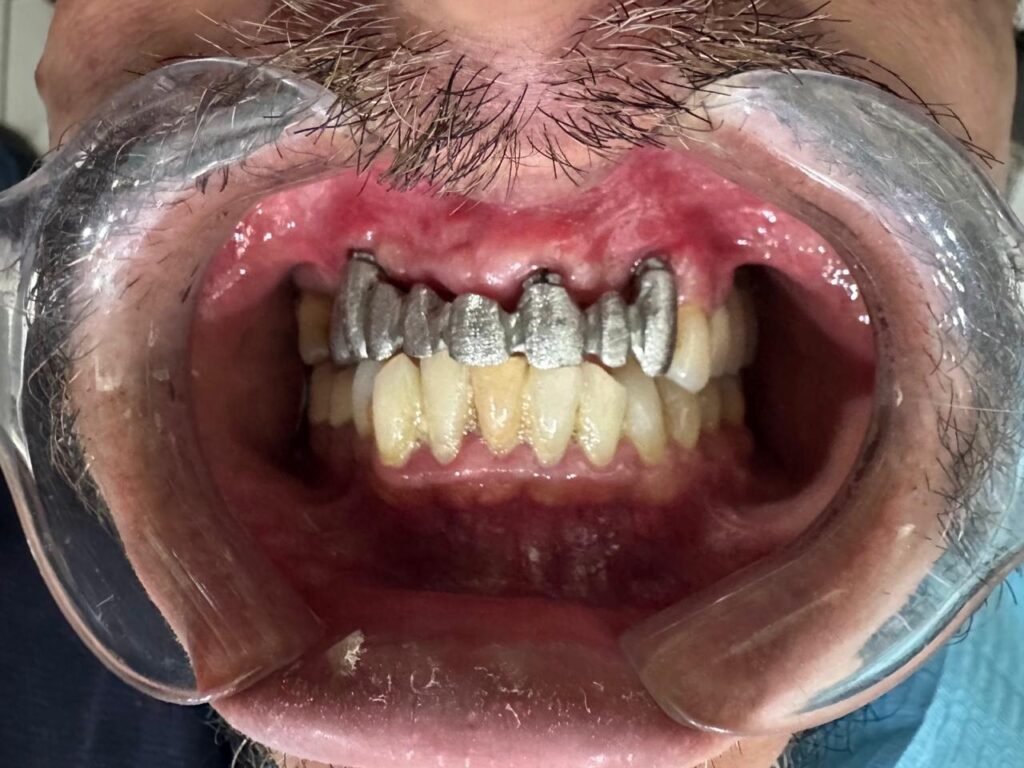
A framework that does not seat passively can place chronic mechanical stress on the implants, even if the patient feels no discomfort at the time, and this stress can contribute to bone loss or screw loosening over years of function. The framework was assessed intraorally and confirmed accurate before Dr. Saqib Minhas approved it for ceramic fabrication, catching any discrepancy at the stage where it is still correctable.
Stage 6: Final Implant-Supported Prosthesis
The final restoration was a cement-retained implant-supported PFM (porcelain fused to metal) bridge, supported entirely by the 4 implants placed earlier in treatment. A total of 8 teeth were restored using this single bridge, meaning each implant carried, on average, two units of the final restoration.
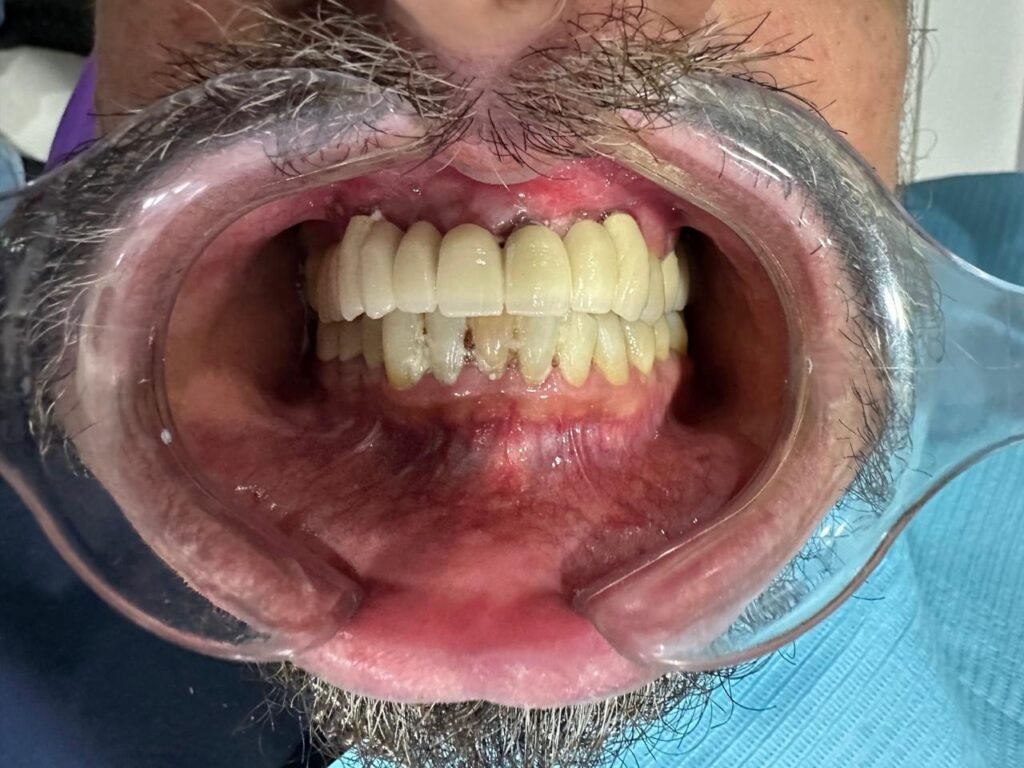
This 2-to-1 ratio of teeth to implants is a deliberate biomechanical choice, not a compromise. When implants are positioned with adequate spread across the arch, a connected bridge distributes occlusal load across all supporting implants as a single unit, rather than concentrating full bite force on a single implant under every tooth. The result for the patient was restored mastication, stable occlusion, and a full smile rebuilt with fewer surgical sites than an implant-per-tooth approach would have required.
Treatment Summary
| Stage | Procedure | Clinical Purpose |
|---|---|---|
| 1 | Extraction of hopeless teeth, healing period | Remove non-restorable teeth, allow soft tissue and bone to stabilize |
| 2 | Interim/temporary denture | Preserve appearance and function, confirm tooth position and bite |
| 3 | Implant healing, healing abutments | Develop and evaluate the soft-tissue emergence profile |
| 4 | Definitive abutment placement | Establish the fixed support structure for the final prosthesis |
| 5 | Metal framework trial | Verify passive fit, accuracy, occlusion, and prosthetic space |
| 6 | Final PFM bridge cementation | Deliver the completed 8-unit restoration on 4 implants |
The Outcome
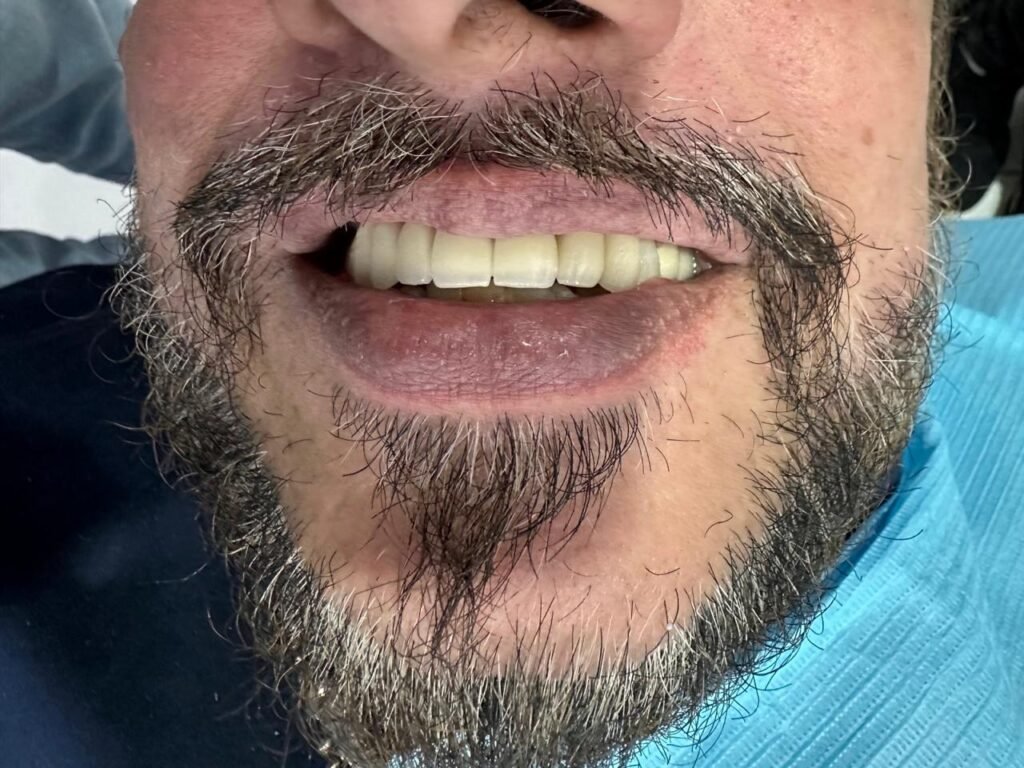
The completed implant-supported PFM bridge delivered a stable, fully functional restoration that integrated naturally with the patient’s bite and facial appearance. Chewing efficiency, speech clarity, and occlusal stability were all restored, and the patient completed treatment with 8 functioning teeth supported by 4 well-integrated implants.
What This Case Demonstrates
This case illustrates why implant rehabilitation outcomes are determined by sequencing and verification, not by the number of implants placed. Removing hopeless teeth, allowing genuine healing rather than calendar-based healing, developing the soft-tissue profile before finalizing abutments, and confirming passive fit before ceramic fabrication are the checkpoints that determine whether a restoration holds up for years rather than months.
It also reflects a planning principle Dr. Saqib Minhas applies consistently in multi-tooth and full-arch cases: the number of implants placed should be based on what the available bone and the biomechanics of the case genuinely require, not simply matched one-to-one against the number of missing teeth. Restoring 8 teeth on 4 correctly positioned implants is frequently the more conservative and more predictable option when the case is planned with this level of detail from the first consultation.
Price Guides
- Hollywood Smile Price
- Metallic Braces Price
- Porcelain Veneers Price
- Wisdom Tooth Extraction Price
- Root Canal Price
Smile Makeover Cost - Teeth Cleaning Price
- Teeth Cap Price
- Dental Bridge Price
- Zirconia Crown Price
Frequently Asked Questions
Yes, provided the remaining bone allows the implants to be positioned with adequate spread across the arch. When implants are placed correctly, they can support a connected bridge that distributes occlusal force across all 4 units rather than requiring a separate implant beneath every tooth.
A temporary denture maintains appearance and chewing function while the implants heal and integrate with the bone, a process that cannot be rushed without risking implant failure. It also allows the patient and dentist to confirm tooth position, bite, and speech before the permanent bridge is fabricated.
A metal framework trial checks that the underlying structure of the bridge seats passively against all implant abutments before the ceramic layer is added. Skipping this step risks a bridge that places uneven stress on the implants, which can shorten the lifespan of the restoration even if no problem is felt immediately.
A connected, cement-retained bridge shares occlusal load across all 4 implants as a single mechanical unit, which is a standard approach when implants are positioned to support a multi-tooth span. Individual crowns on each implant are a different design choice, typically used when each implant needs to function independently.
Total treatment time depends on individual healing response, but a staged protocol involving extraction, implant integration, emergence profile development, and framework verification typically spans several months. Each stage is only advanced once the biological or mechanical requirement for that stage has been met, not on a fixed schedule.
The final PFM bridge is a fixed, long-term restoration rather than a removable one, though like any dental prosthesis it requires routine maintenance, regular check-ups, and good oral hygiene to sustain its function over time. Cement-retained bridges can be professionally removed for maintenance if a specific implant or component ever needs attention.
Get Expert Implant Care at The Dental Clinic
Cases involving multiple failing teeth call for a dentist who can plan the entire sequence in advance, not one who places implants and adjusts course as problems appear. The Dental Clinic in Gulshan-e-Iqbal, Karachi manages this kind of multi-stage implant rehabilitation as a routine part of its clinical practice.
Dr. Saqib Minhas holds a postgraduate qualification in Clinical Implantology. With 18 years of specialist experience across implantology, periodontics, and prosthodontics, he is equipped to plan cases of this complexity with the precision that multi-tooth, multi-stage implant rehabilitation requires.
If you are dealing with multiple failing teeth and want a treatment plan that accounts for every stage from extraction to final bridge, book a consultation at The Dental Clinic or call 0316-0200011.